No products in the cart.
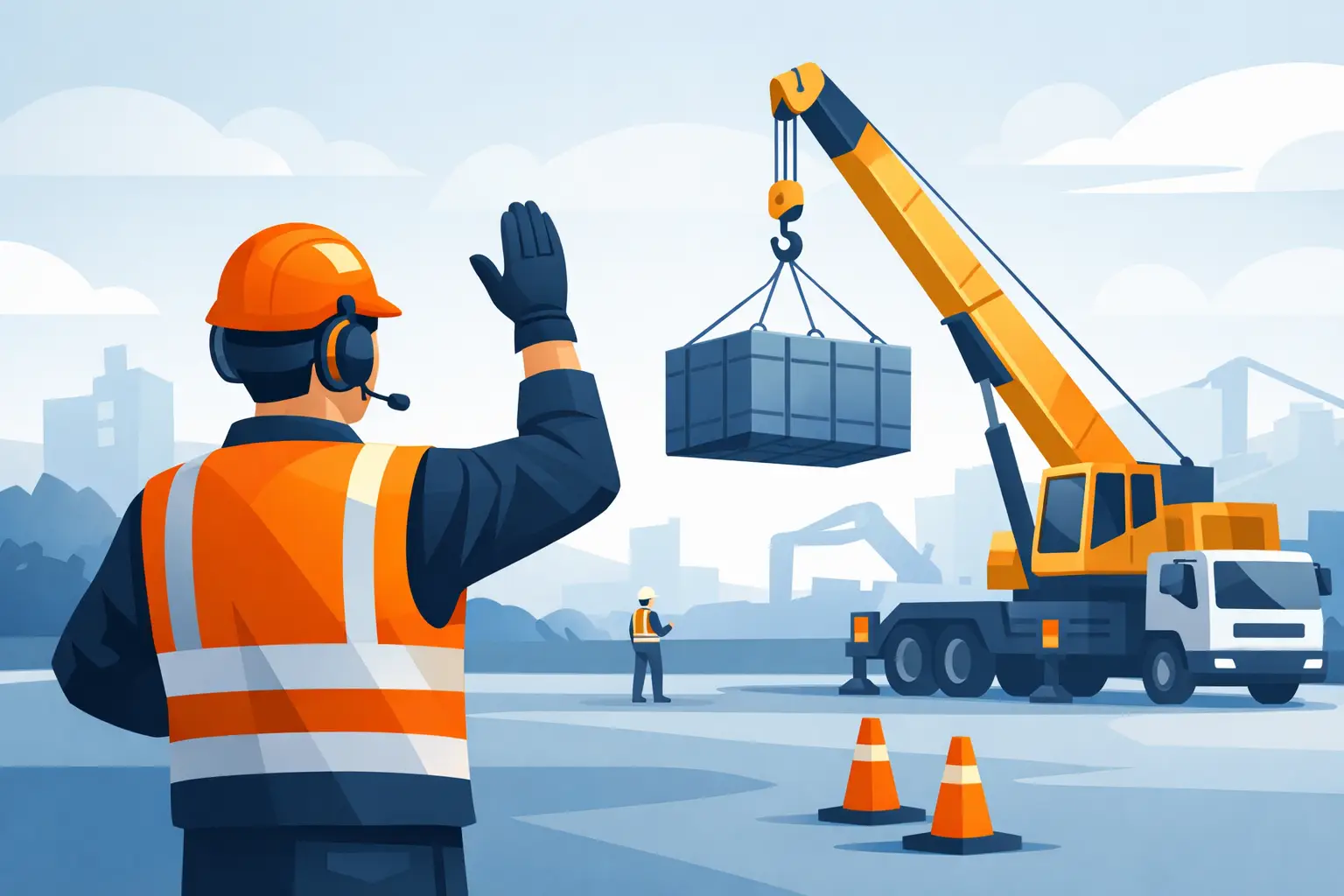
Misunderstood signals on a work site can lead to delays at best and serious incidents at worst. That is why banksman hand signals matter so much. When vehicles, plant and pedestrians are all moving in the same space, clear visual communication helps keep operations controlled, efficient and far safer.
A banksman acts as the driver’s eyes and guide when visibility is limited or manoeuvres are difficult. You will often see this role used around reversing vehicles, loading areas, lifting operations and tight site access points. The job sounds simple on paper, but in practice it depends on precision, consistency and confidence. A vague gesture is not enough. The signal must be recognised instantly and understood in the same way by everyone involved.
For learners building construction or workplace safety knowledge, this is one of those subjects that has a direct link to employability. Employers want staff who understand safe systems of work, not just the theory behind them. Knowing how banksman signalling works shows awareness of site risk, communication standards and legal responsibilities.
What are banksman hand signals?
Banksman hand signals are standard visual instructions used to direct a driver or plant operator during manoeuvres. They are most commonly used when a vehicle is reversing, approaching a loading bay, turning in a restricted area or moving where the operator does not have a full view.
The purpose is straightforward. A single trained person communicates clear instructions so the driver can move safely without relying on guesswork. This reduces the chance of collisions with people, structures, equipment or other vehicles.
In many workplaces, verbal instructions are unreliable. Engines are loud, weather can affect hearing, and radio communication is not always available or practical. Hand signals cut through that problem. They give an immediate, visible instruction that can be followed at a glance.
That said, hand signals only work when they are agreed, standardised and used properly. If one site uses informal gestures and another uses recognised signals, confusion can creep in quickly. That is why training and consistency matter.
Why correct signalling matters on site
Reversing vehicles remain one of the biggest hazards in construction, warehousing, logistics and industrial settings. Blind spots, uneven ground, time pressure and mixed pedestrian traffic all increase the risk. A trained banksman helps create order in situations where one mistake can have serious consequences.
Good signalling does more than prevent accidents. It also improves workflow. Drivers can position vehicles faster, loading operations run more smoothly, and teams spend less time correcting poor manoeuvres. On a busy site, that efficiency adds up.
There is also a legal and professional angle. Employers have a duty to reduce workplace risks as far as reasonably practicable. Where vehicle movement presents a hazard, competent supervision and communication arrangements are part of that duty. A banksman is not a formality. It is a control measure.
Common banksman hand signals
While exact site rules may vary, several signals are widely recognised and should be taught clearly during training. The key point is not only what the signal looks like, but what it means in real working conditions.
The stop signal is the most important of all. It must be immediate, clear and never open to interpretation. If the banksman sees danger, the instruction to stop should override every other movement. Drivers and operators need to understand that this signal means halt at once.
The move forwards and move backwards signals are used to guide gradual vehicle movement. These are typically controlled arm motions that show direction clearly. They should be delivered at a pace that matches the manoeuvre. Fast, exaggerated gestures can create panic or confusion, especially in tight spaces.
Signals for turning left or right help a driver align the vehicle safely. These are particularly important when a vehicle is entering a narrow route, passing obstacles or positioning for unloading. The banksman must give the instruction early enough for the driver to react safely.
There is often a slow down signal as well. This is useful when the vehicle is moving correctly but too quickly for the conditions. It gives the driver a chance to reduce speed without stopping the whole operation.
Some tasks also involve signals for raising or lowering equipment, especially where lifting operations and plant movement overlap. In these settings, everyone must know exactly which signal set is being used. Mixing traffic marshalling signals with lifting signals without clear briefing can create unnecessary risk.
When hand signals are not enough
It is tempting to think signalling alone solves the problem, but that is not how safe site management works. Banksman hand signals are one part of a wider system. They are most effective when supported by proper planning, site layout, trained staff and defined traffic routes.
For example, if a banksman is standing in a poor position, the driver may lose sight of them at the critical moment. If lighting is poor, even a correct signal may not be visible. If pedestrians are allowed to cross vehicle routes freely, the banksman may be overwhelmed by competing hazards.
This is where competence becomes crucial. A banksman needs more than a memorised list of gestures. They need situational awareness, authority to stop work, and a clear understanding of the vehicle’s path, blind spots and escape zones.
The qualities of an effective banksman
A good banksman is calm, visible and consistent. They do not over-signal or improvise. They choose a safe position where the driver can see them clearly and where they themselves are not trapped by the moving vehicle.
They also maintain eye contact where possible. If the driver cannot see the banksman, the manoeuvre should not continue. This rule is simple, but it is one of the most important principles in vehicle marshalling.
Confidence matters too. Unclear body language can undermine the message. A hesitant stop signal or a half-hearted direction change can lead to delay or a dangerous assumption. Training helps learners develop the confidence to communicate with authority while staying within safe procedure.
Just as important is understanding limits. A banksman should never stand directly behind a reversing vehicle in a way that puts them at risk. They should not assume the driver has seen a hazard unless communication is confirmed. And they should not continue a manoeuvre when visibility is broken.
Mistakes that cause confusion
Many signalling problems come from informal habits rather than total lack of knowledge. One common issue is using signals that are too small or too casual to be seen clearly. On a noisy, active site, subtle hand movements are easy to miss.
Another is giving multiple instructions too quickly. If the banksman signals to reverse, then turn, then slow down in rapid sequence, the driver may only catch part of the message. Clear sequencing is safer than rushed communication.
There is also the problem of too many people directing one vehicle. A driver should receive instructions from one designated banksman, not from several workers pointing in different directions. Mixed signals create hesitation and increase the chance of a wrong move.
Finally, some workers rely on experience and skip refresher learning. That can be a mistake. Standards, site practices and risk awareness all benefit from formal training, especially for people moving into new roles or industries.
Why training makes a real difference
For many adult learners, site safety training is not just about passing a course. It is about building practical confidence that employers value. Understanding banksman hand signals can support roles in construction, warehousing, logistics, facilities and other safety-sensitive environments.
Good training explains the signals themselves, but it should also cover when to use them, where to stand, how to assess risk and what to do if visibility is lost. That wider context is what turns knowledge into workplace competence.
Flexible online learning can be especially useful here. It allows learners to study around shifts, family life and existing responsibilities while gaining recognised knowledge that supports progression. For employers, it can also make team training easier to roll out consistently across multiple staff members.
Skill Touch serves learners who want that balance of accessibility and practical value. For anyone improving site safety knowledge or working towards better job opportunities, understanding vehicle marshalling principles is a smart investment.
Who needs to understand banksman hand signals?
This knowledge is not limited to dedicated banksmen. Site supervisors, plant operators, drivers, warehouse staff and health and safety learners all benefit from understanding the same signal language. Even when someone is not performing the role directly, awareness helps them recognise safe practice and respond appropriately around moving vehicles.
It is particularly useful for career changers and entry-level workers entering construction or industrial environments for the first time. Learning the basics early can make site inductions easier to follow and help new starters feel more confident in practical settings.
For employers, shared understanding across the workforce improves consistency. It is much easier to maintain control when everyone knows what the signals mean and why they are used.
Banksman hand signals as part of safer working
The best way to think about banksman hand signals is not as a box-ticking requirement, but as part of a safer working culture. They support communication, reduce uncertainty and help people make better decisions under pressure. On busy sites, that clarity matters.
If you are building your safety knowledge for a current role or your next opportunity, this is one of those core topics worth learning properly. Clear signals, competent training and good site discipline can make the difference between a controlled manoeuvre and a preventable incident.