

No products in the cart.
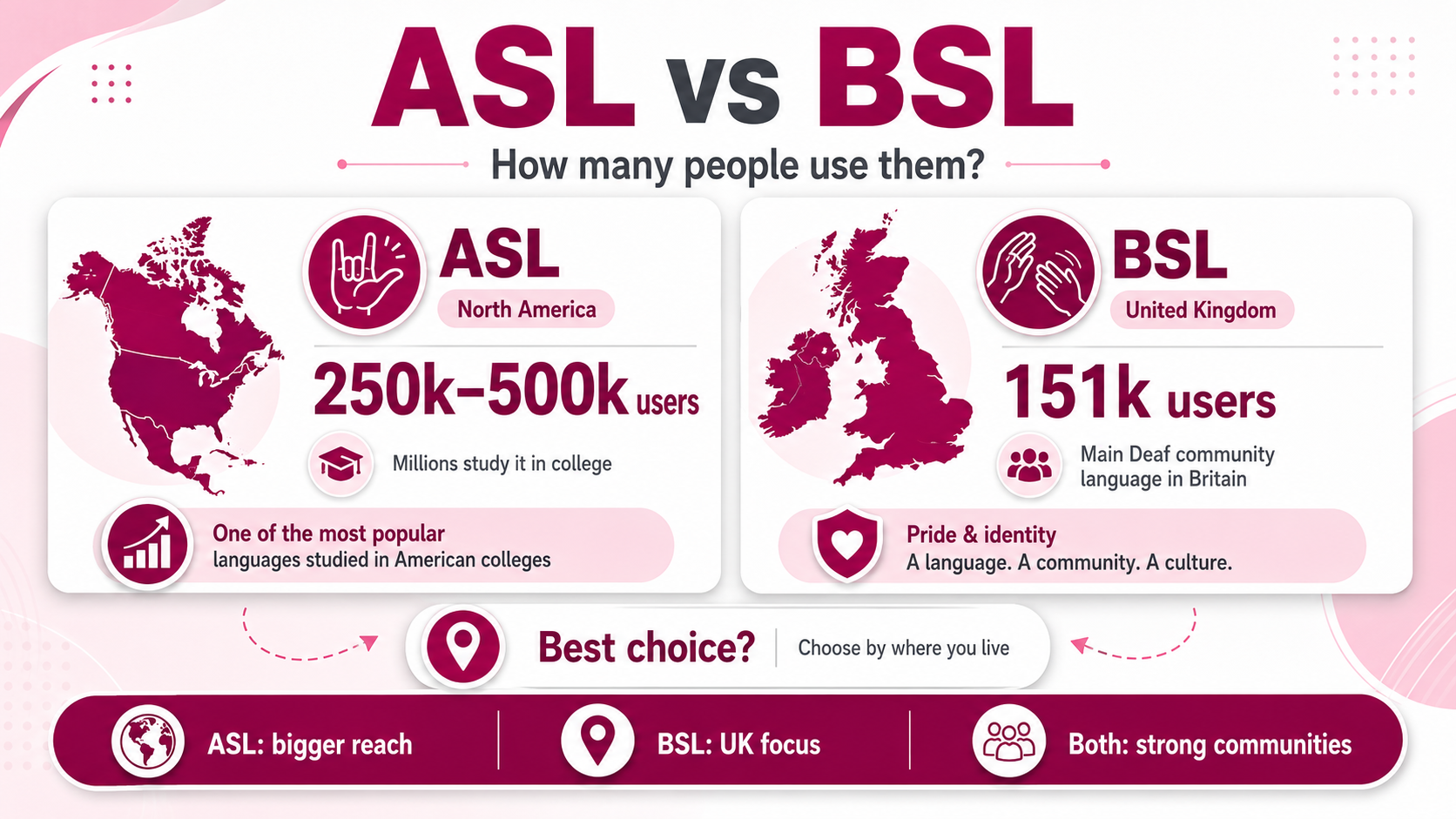
Sign language helps people communicate without using spoken words. Around the world, millions of Deaf and hard-of-hearing people use sign language every day. Two of the most well-known sign languages are American Sign Language and British Sign Language. An estimated 250,000 to 500,000 people use ASL. At the same time, about 151,000 people use BSL across the UK. However, the difference between ASL and BSL is much greater than most people realise.
Many people assume these languages are the same because both use hand signs. But they have different grammar rules, sentence structures, finger-spelling systems, and signs. In addition, each language has its own history, culture and identity.
Let’s look at the main differences between ASL and BSL.
How Does History Explain the Difference Between ASL and BSL?
Thomas Braidwood opened a famous school in Scotland way back in 1760. His family shared these British signs across the whole United Kingdom later. Then, a man named Thomas Gallaudet wanted help for Americans. He visited London to find teachers for his new school project. The surprising thing is that the British schools refused to share secrets.
Instead, Gallaudet went to France to find a better teacher for his students. He met a man named Laurent Clerc in Paris. They brought French signs back to America and started a school. So, ASL actually follows a French style of signing today. Specifically, it is related to French Sign Language. Similarly, BSL stayed independent and grew its own unique British way over many years.
Why are the Manual Alphabets So Different?
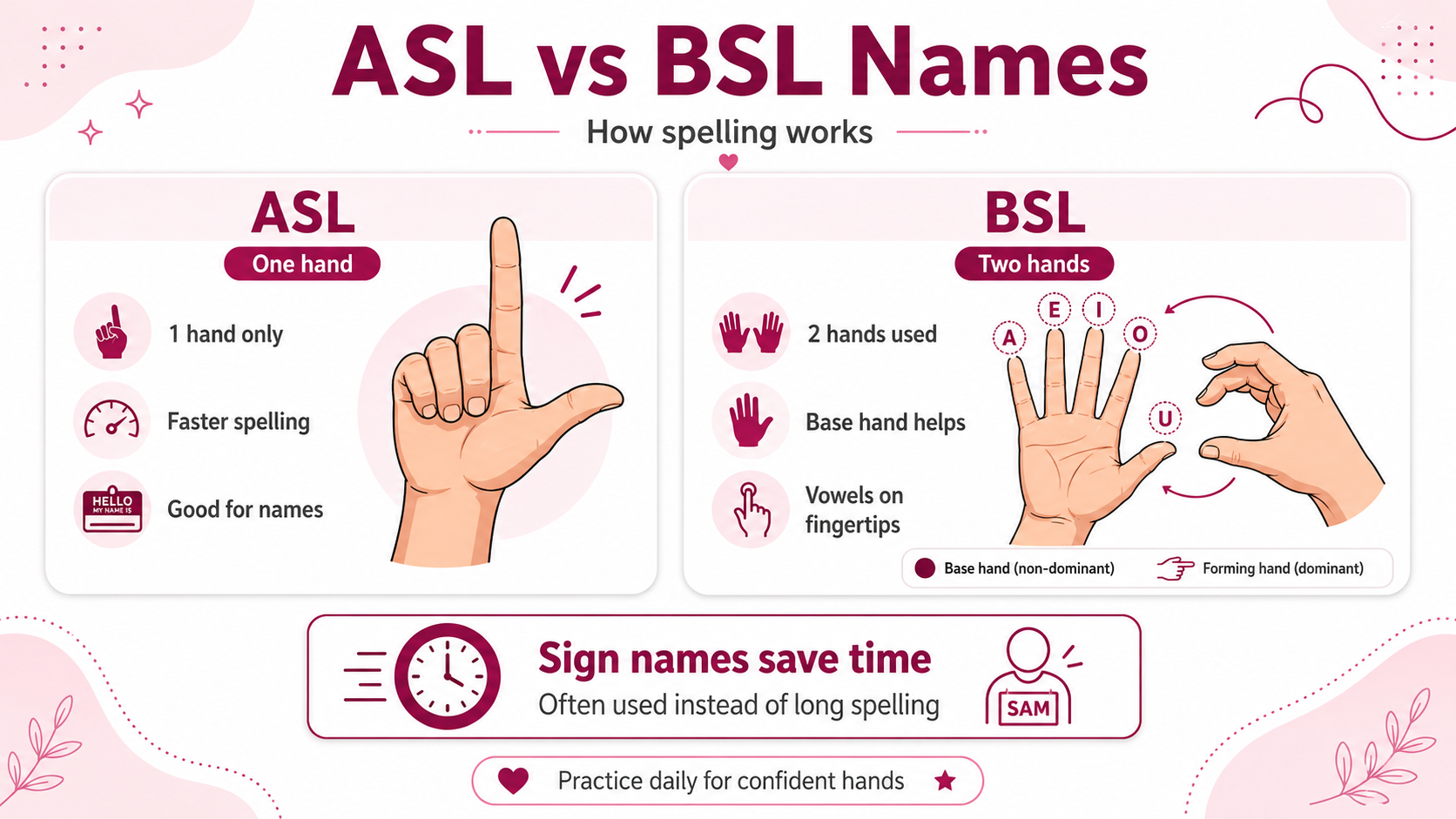
ASL uses a one-handed alphabet, while BSL uses a two-handed alphabet. So, spelling looks very different in both languages. ASL uses one hand for each letter. BSL uses both hands to form letters. This is why beginners must learn the correct system for their country.
- ASL uses only one hand for all 26 letters of the alphabet.
- BSL requires both hands to work together for most letters.
- British signers point to their fingertips to show vowels like A and E.
- American Signers change their hand shape to show every single letter.
Is the Grammar Order Different in These Languages?
Sentence rules show another major factor in these two systems. Both languages ignore the order of spoken English words entirely. Actually, ASL users often follow a “Topic-Comment” style for their sentences. This means you sign the main subject before you sign the action. But BSL uses its own unique logic for spatial mapping instead.
Specifically, you place objects in the air to set visual scenes. It is like drawing a map with your hands in front of your chest. Honestly, your eyebrows act like punctuation marks for every single sign. The position of your body shows who is currently speaking. So, you must learn to think visually for every conversation you have. Anyway, mastering the grammar takes a lot of regular practice time.
How Many People Use These Sign Languages?
Learning about the number of users helps us see the scale of these communities. Around 250,000 to 500,000 people use ASL in North America. In contrast, about 151,000 people use BSL across the United Kingdom. Understanding the size of each group can help learners choose the right path.
Truthfully, millions of people study ASL in American colleges every year. It is one of the most popular languages to learn in school. But BSL is the primary language for the Deaf community in Britain. So, your choice of language depends on where you live today. Overall, these differences make every community very proud and strong.
Why Do Numbers Look Different in ASL and BSL?
Counting in ASL and BSL is quite different. ASL uses one hand to count up to ten. Numbers change with hand direction after five. BSL often uses different hand shapes and sometimes both hands for larger numbers. For example, “three” uses the thumb in ASL, but three fingers in BSL. So learners must follow the correct system to avoid confusion. Practising numbers daily helps you become faster and more confident.
- ASL signers can count from one to ten using only one hand.
- BSL signers usually bring in their second hand for numbers over five.
- The handshape for the number “3” is totally different in each system.
- Palm direction tells the listener if the number is a count or a date.
Why is the Difference Between ASL and BSL Important for Students?
Living in the United Kingdom makes BSL the best choice for you. Most Deaf people in Britain only use the British system daily. So, ASL skills will not help you during local meetings or events. But BSL is the primary language for UK schools and hospitals now.
Truthfully, learning local signs helps you find many new friends quickly. Understanding the difference between ASL and BSL ensures you don’t learn the wrong signs. So, you will feel more at home in your own community.
Anyway, focusing on BSL ensures that people understand you every single day. Overall, this choice shows respect for the local British culture. You should join a local class today to start your journey. It is very rewarding to learn.
Can American and British Signers Understand Each Other?
A British signer and an American signer may struggle to communicate. They share only a few similar signs in their daily lives. Both languages use different grammar, rules, and sentence structures. They also come from different cultures and histories.
So, they work like separate languages, just like Spanish and Italian. Each one has its own identity and system. Learning this helps us respect Deaf communities and their diversity. Specifically, you cannot just move to London and use ASL.
People might understand basic gestures, but they won’t follow your sentences. Honestly, it is better to learn the specific language of the country you visit. Anyway, some signs for simple things like “food” might be similar. Overall, they are two different worlds of communication.
How Does This Difference Affect Spelling Names?
Spelling names is different in ASL and BSL. BSL uses two hands for each letter, so it looks more active. ASL uses only one hand, which allows faster spelling. Both systems help with new words and names. Signers also use special sign names based on personality. Learning the alphabet is an important first step for beginners. Daily practice helps your hands feel more natural and confident.
- ASL fingerspelling is done entirely with the dominant hand.
- BSL fingerspelling uses the non-dominant hand as a “base” for the letters.
- Vowels in BSL are easy to find because they are on your fingertips.
- Sign names are often used instead of spelling out long names every time.
What Role Do Facial Expressions Play in Signing?
Your face helps people understand the true meaning of your signs. Actually, facial expressions act like the tone of your spoken voice. If you look happy, the sign feels happy to the viewer. But if you look seriously, the meaning of the sign changes. Specifically, your eyebrows work like punctuation marks for every sentence.
They show if you are asking a question or making a statement. Honestly, signing without expressions is like reading a very robotic book. It makes the conversation very boring for the listener to follow. You should practise your expressions in a mirror every morning. This helps your face become more active and expressive during talk. So, don’t be shy to move your face while you sign to your friends.
Why is BSL Officially Recognised in Britain?
BSL gained official recognition in 2003 in the UK. This was a major win for Deaf people across the country. Today, BSL interpreters appear on TV and many schools and hospitals support it. This recognition shows BSL is a real and important language.
It also helps protect it for future generations of signers. Learning even a few signs can build confidence and open a new way to communicate. Truthfully, it makes the community feel respected and heard by the government.
So, more people now take classes. Anyway, recognition of the language gives everyone better access. Overall, it is a great time to be a student of sign language. Specifically, it helps build a more inclusive world for every single person.
How Can a Beginner Start Learning?
Starting your signing journey is a very exciting step to take. Actually, you can find many local classes in your city easily. Most colleges offer beginner courses for a very small fee. Then, you can practise your hand shapes with new friends. But you must stay consistent with your practice every single week.
Also, watching videos online helps you see the signs clearly. So, do not be afraid to make small mistakes daily. Truthfully, native signers are very happy to help new students learn. Anyway, picking up a few signs each day builds your confidence. Overall, you will discover a whole new way of talking. Start today and enjoy the beauty of visual communication. Specifically, it is a skill that will stay with you forever.
Final Thoughts
So, not all sign languages are the same, even if they look similar. The difference between ASL and BSL shows in their grammar, vocabulary, and hand movements. ASL is widely used in North America. At the same time, BSL is used in the UK. Each has its own cultural background and special history. Knowing the difference helps learners communicate better and avoid misunderstandings. Anyway, both languages are beautiful ways to express thoughts and feelings. Overall, learning any sign language is a wonderful way to connect with others.
FAQs
1. Is It Better to Learn ASL or BSL?
- It depends on where you live and which Deaf community you want to communicate with.
2. Can ASL Users Understand BSL?
- No, most ASL users cannot easily understand BSL because the two languages are very different.
3. Does the UK Use ASL or BSL?
- The UK mainly uses BSL, which is the national sign language of the British Deaf community.
4. Which Is Harder, BSL or ASL?
- Neither language is harder overall, as the difficulty depends on your learning style and experience.
5. Why Was BSL Banned in the UK?
- BSL was never officially banned, but many schools discouraged its use during the late 19th and 20th centuries.
6. What Is “I Love You” in BSL?
- In BSL, people usually sign “I”, “love”, and “you” separately to express the phrase.
7. How Do I Say “I’m Sorry” in BSL?
- You can sign “sorry” by making a circular movement on your chest with a closed hand.
8. What Is the No. 1 Hardest Language to Learn?
- Many experts consider Mandarin Chinese one of the hardest languages for English speakers to learn.