No products in the cart.
If you have ever stood in the supermarket comparing hard Italian cheeses and wondering, is grana padano vegetarian, you are not alone. It looks similar to Parmesan, it is widely used in pasta dishes and salads, and it often appears in foods labelled simply as “Italian hard cheese”. But for vegetarians, the real question is not how it tastes. It is how it is made.
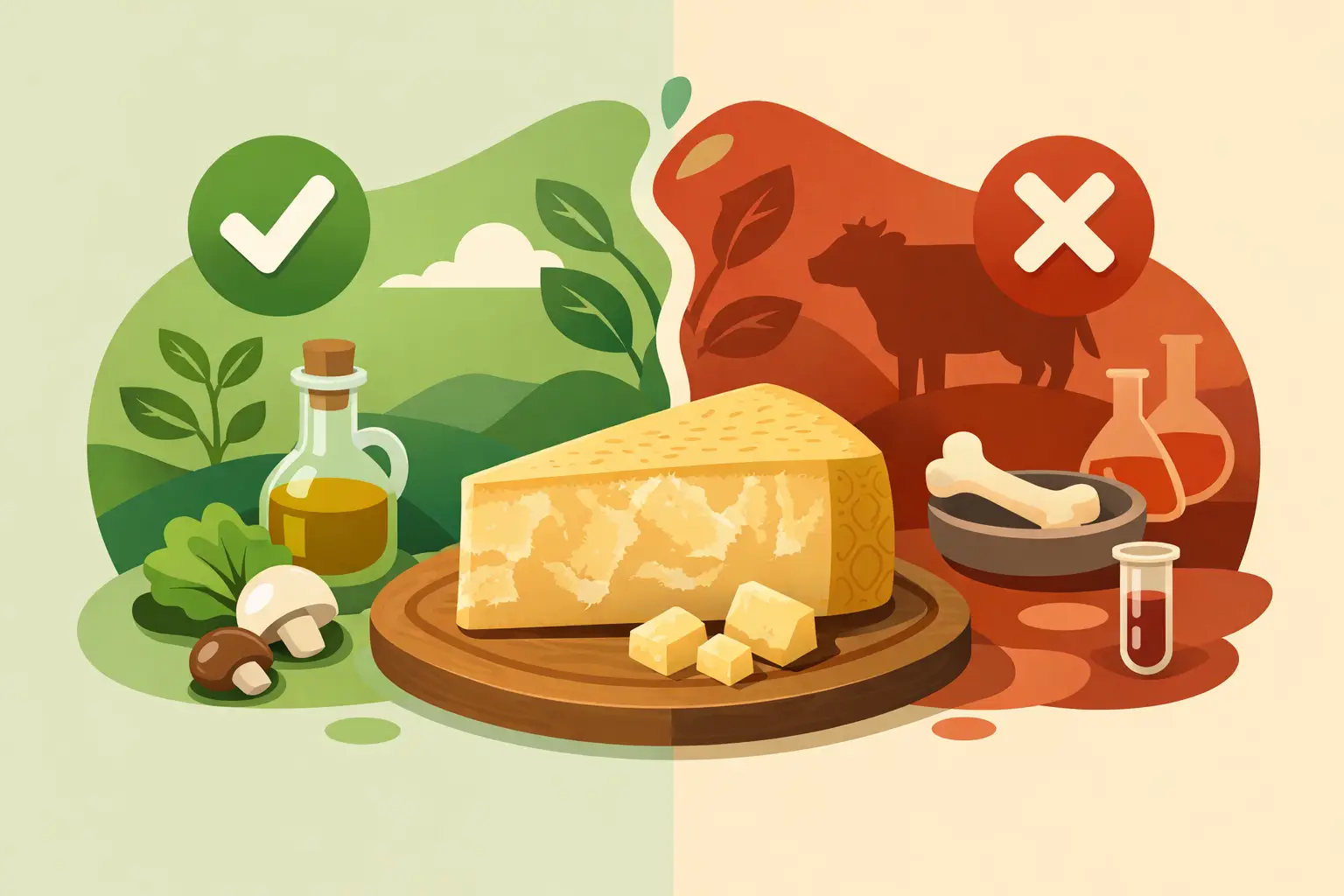
The short answer is no – Grana Padano is generally not considered vegetarian. The reason comes down to rennet, an ingredient used in cheesemaking that many shoppers do not see until they look closely.
Why Grana Padano is usually not vegetarian
Grana Padano is a protected Italian cheese made under strict production rules. Those rules cover where it is produced, how it is aged, and the ingredients used in the process. One of those ingredients is rennet.
Traditional Grana Padano uses animal rennet, which is taken from the stomach lining of young calves. That means it is not suitable for most vegetarians, even though it contains no visible meat or fish. This is where people often get caught out. A cheese can seem vegetarian because it is dairy-based, but the production method may still involve animal-derived ingredients.
For anyone following a vegetarian diet for ethical, religious, or lifestyle reasons, that distinction matters. It is also a useful reminder that ingredient knowledge is part of informed food choice. Whether you work in catering, food retail, hospitality, or simply want to make better decisions at home, understanding labels can help you avoid mistakes.
What is rennet and why does it matter?
Rennet is used to coagulate milk, helping it separate into curds and whey. Without it, many traditional cheeses would not develop their familiar texture and structure.
There are different types of rennet. Animal rennet comes from calves or other young animals. Vegetarian alternatives include microbial rennet, which is produced by fungi or bacteria, and fermentation-produced chymosin, which is made using biotechnology. These alternatives do the same basic job, but they are suitable for vegetarians.
That is why two cheeses can look almost identical on the shelf but differ completely in suitability. If one uses animal rennet and the other uses microbial or vegetarian rennet, only one will fit a vegetarian diet.
In practical terms, this matters beyond personal shopping. If you are preparing food for others, serving customers, or planning menus, knowing the rennet source can help you avoid mislabelling a dish. In professional settings, especially food service, accuracy is part of trust.
Is Grana Padano different from Parmesan?
Many people ask about Grana Padano because they already know Parmesan is often not vegetarian. The confusion is understandable. The two cheeses are similar in appearance, texture, and use.
Both are hard, aged Italian cheeses. Both are commonly grated over pasta, risotto, soups, and vegetable dishes. Both have rich, savoury flavours. And both are traditionally made with animal rennet.
So if you avoid Parmesan because it is not vegetarian, the same caution usually applies to Grana Padano.
There are differences between the cheeses in terms of ageing, flavour profile, and regional production, but those details do not change the main answer for vegetarians. From a suitability point of view, they fall into the same category more often than not.
Can any version of Grana Padano be vegetarian?
This is where the answer needs a little nuance. Authentic Grana Padano made under official production rules is not vegetarian because of the required use of animal rennet. So if the product is genuinely labelled and sold as Grana Padano PDO, it should not be treated as vegetarian.
However, you may find cheeses described in more general terms such as “Italian hard cheese”, “Grana-style cheese”, or “similar to Grana Padano” that are made with vegetarian rennet. These are not the same thing as official Grana Padano, even if they are designed to offer a similar taste and texture.
That distinction is worth paying attention to. A vegetarian-friendly alternative may work perfectly well in cooking, but it will usually be a different product, not a vegetarian version of the protected cheese itself.
How to check whether a cheese is vegetarian
If you are buying cheese for yourself or for others, the simplest approach is to check the label carefully. Terms such as “animal rennet”, “rennet”, or “calf rennet” are signs the cheese is not vegetarian. Labels that say “vegetarian”, “suitable for vegetarians”, or “made with microbial rennet” usually offer a clearer answer.
That said, labels are not always consistent. Some products list rennet without saying where it comes from. Others use technical wording that is easy to miss if you are shopping quickly.
A sensible approach is to look for three things. First, check whether the packaging explicitly says it is suitable for vegetarians. Second, read the ingredient list for the type of rennet used. Third, if the cheese is a protected traditional product such as Grana Padano or Parmigiano Reggiano, assume it is not vegetarian unless the producer states otherwise.
This matters even more with pre-prepared foods. Ready meals, sandwiches, pasta sauces, salads, and baked dishes may contain grated hard cheese without making the source obvious on the front of the packaging. The back label is where the useful detail usually sits.
Why this question matters in everyday life
For some people, this is a small preference. For others, it is a firm dietary boundary. Either way, being able to answer “is Grana Padano vegetarian?” helps people make confident choices.
It also highlights how food knowledge supports wider skills. Reading labels, understanding ingredients, and spotting hidden animal products are practical abilities that support healthier, more informed decisions. For workers in catering, hospitality, education, and care settings, these details can be especially important because they affect service standards and inclusion.
When dietary needs are handled well, people feel respected and safe. When assumptions are made, mistakes happen. A cheese board marked “vegetarian” that includes Grana Padano is not a minor issue to someone who relies on accurate information.
That is one reason food awareness training remains valuable. Whether you are improving your own knowledge or building professional skills through flexible learning with providers such as Skill Touch, understanding what sits behind a label can make day-to-day decisions much easier.
Common situations where people get confused
One common issue is assuming all cheese is vegetarian because it is made from milk. Another is relying on restaurant descriptions that list a dish as meat-free without confirming whether the cheese uses animal rennet.
Packaged foods can be misleading too. A pasta bake labelled “vegetable” may still contain non-vegetarian cheese. A supermarket pizza may seem suitable until you check the small print. Even snack products such as cheese twists, crisps, and filled pastries can include Grana Padano or Parmesan-style cheese.
There is also confusion between vegetarian and vegan. Grana Padano is neither vegetarian, in the usual dietary sense, nor vegan. It is an animal-derived dairy product that also uses animal rennet. Someone avoiding all animal products would need a fully plant-based alternative, while a vegetarian looking for a similar flavour could choose a hard cheese made with vegetarian rennet.
Best alternatives for vegetarians
If you enjoy the salty, nutty flavour of Grana Padano, you do have options. Many supermarkets now stock hard cheeses made with vegetarian rennet. These are often labelled as Italian hard cheese or vegetarian hard cheese and can be grated, shaved, or cooked in the same way.
The taste will vary. Some alternatives are milder, while others aim for a stronger, aged flavour. Texture can differ slightly too, especially in dishes where the cheese is the main flavour rather than a finishing touch. Still, for most home cooking, the swap is straightforward.
If you are serving guests or choosing ingredients for shared meals, using a clearly labelled vegetarian hard cheese is often the safest route. It removes uncertainty and makes catering for mixed dietary preferences much easier.
The simple answer to remember
So, is Grana Padano vegetarian? In most cases, no. Authentic Grana Padano is made with animal rennet, which means it is not suitable for vegetarians.
If you want the flavour and function of this style of cheese without the animal rennet, look for a vegetarian-labelled hard Italian cheese instead. That one habit – checking the label rather than the name alone – can save time, prevent mistakes, and help you make food choices with confidence.